
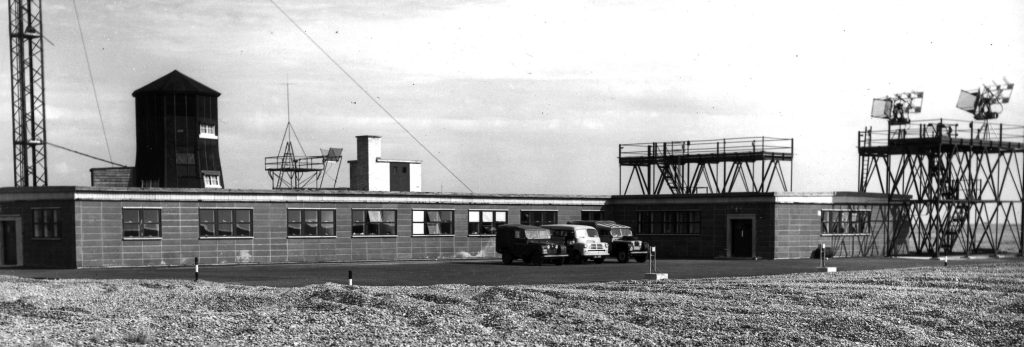
The Telemetry Building on Orford Ness, photographed in August 1956. The Black Beacon is visible in the background. Corner reflector aerials and helical arrays are visible on the framework at the right. © Crown Copyright / AWE 2021. Contains public sector information licenced under the Open Government Licence V3.0.
Telemetry and electronic systems testing on Orford Ness
What is telemetry?
Telemetry is the art of measurement at a distance, whereby a physical quantity being measured is transmitted to a distant station and there indicating or recording the quantity measured. 1
An example might be for an air-drop test of a bomb casing. A test parameter of interest, e.g. tail fin flutter, could be measured by a strain gauge transducer, converted into a radio signal by an onboard telemetering unit, and the results displayed or recorded at the receiving station.
Strictly speaking, telemetry covers transmission of data by wired as well as wireless techniques, so some of the first applications go back to the 19th century. 2
In the context of Orford Ness, we are mainly considering wireless telemetry, where the device under investigation is either airborne (e.g. a bomb casing dropped from an aircraft) or where the radio transmission features of a weapon are under investigation (e.g. the Blue Streak test rig).
It is possible that Orford Ness was involved in telemetry in the pre-AWRE era. The Royal Aircraft Establishment was looking at telemetry as a tool to assist in bomb ballistic measurements, circa 1950. This is the subject of ongoing IRGON research. 3
The state of the art in the mid-1950s
Since WW2 the science of telemetry was making great strides, due to the development of guided weapons and progress in the field of electronics.
In the UK, a number of telemetry systems had been developed independently 4, by 1955 there were systems developed by EMI, Murphy, Bristol GW division (probably to support Red Duster) and Vickers GW Division. 5
Efforts were made to standardise the expensive and time-consuming process of designing and manufacturing telemetry systems. The Officer in Charge at AWRE Orford Ness made the following statement in 1958: “There is no doubt that many of the major requirements for telemetry can be satisfied by a common solution although it would be wrong to underestimate the difficulties in reaching common agreement with the several organisations involved”. 6
The Signals Research and Development Establishment (SRDE) in Christchurch, Hants made a proposal for a higher capacity telemetry system in 1953. 7
The Radio Department of the Royal Aircraft Establishment was also proposing their own version of a standardised telemetry system 8 and there was some argument about the merits of the two systems. 9
In July 1955, a team from the Guided Weapons Department of the Royal Aircraft Establishment visited the United States to establish an overview of US telemetry practice. 10 The RAE Radio Department was tasked with telemetry design for the Blue Streak MRBM programme (but just for the missile body: see the section on Blue Streak below) 11, and understandably needed to grasp the state of the art in the USA with its plethora of defence projects. They visited Patrick AFB, White Sands, JPL and other establishments, and were able to produce a report covering telemetry subjects like antenna design (both airborne and ground), telemetry problems of re-entry vehicles, and many other topics.
The importance of air-to-ground telemetry in British weapons development
The complexity of nuclear weapons with their various fusing arrangements, safety and arming devices was a challenge for the industry. Although the fields of radio and electronics were making huge strides in the 1950s, the difficulty was the “systems engineering” aspect. A weaponised nuclear device had to fit into an aerodynamic casing, and withstand the stresses of vibration, temperature and pressure encountered during a bomber sortie.
The scope for ground testing in the latter half of the 1950s was limited. Vibration testing was in its infancy. The first vibration laboratory constructed on Orford Ness, Lab 1, was not ready until April 1956, and the vibration machinery took some additional time to reach a usable state.
The solution was to fly models of the weapons fitted with the various critical components under test (e.g. turbo-generators for Red Beard and Yellow Sun, firing circuits, fusing units etc.). These test vehicles could be full-size models of the weapons concerned, or in the case of larger weapons like Yellow Sun, scale models when practical as the availability of V-bombers was a critical bottleneck. A scale model could be carried by a Canberra, and released at a realistic altitude and airspeed commensurate with a real sortie in a V bomber.
AWRE context and trials
The second half of the 1950s was characterised by intensive efforts on the UK’s nuclear deterrent. In 1955, Britain announced its intention to develop a hydrogen bomb, and by 1957 testing was being carried out in the Pacific Ocean (Operation Grapple). A 1958 AWRE document 12 states “The pressure of the Grapple series has stripped Aldermaston of all R. & D. effort on airborne telemetry. Consequently all the design work on the Red Beard, Yellow Sun and long term successors to these is now centred at Orfordness.”
There is evidence to show that up to 1957, Orford Ness was the only test range fully instrumented to AWRE standard. 13 Other ranges (notably Imber, for impact trials of RED BEARD, and WRE in Australia), were improved to this standard as the weapons programmes progressed.
We know that one of the first construction projects by AWRE on Orford Ness was the Telemetry Building (even before the various labs).
Blue Danube
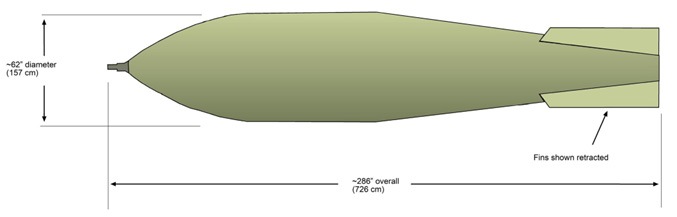
Warhead telemetry for the later weapons is still classified. However there is some information available on Blue Danube. Critical to the operation of the warhead was the multipoint detonation of the thirty-two detonators. This had to be achieved simultaneously (in practice, ±0.1μsecs). The “exploder scatter” was transmitted by the telemetry system. The altitude of the bomb at the point of firing was also a critical telemetered measurement. 14
Yellow Sun
Yellow Sun was a megaton free-fall bomb produced in response to Air Ministry requirement OR.1136 15 succeeding the “interim megaton weapon” Violet Club. The trials team had to maintain and calibrate the trials equipment; run the telemetry operations from six locations (5 of them on the Ness, and a sixth at Brackenbury Fort, Felixstowe). They were of course also responsible for computing, recording and reporting the results, and were expected to develop new trials control techniques as the need arose. 16
Yellow Sun needed a 24 channel F.M. telemetry system, 6 channels being used to transmit vibration data. Telemetry flight tests were scheduled to begin in December 1957. 17
Development problems were encountered with the pulse circuitry for the external neutron initiator.
Besides actual trials work, there was considerable R&D effort going on in the telemetry field. For Yellow Sun, development work was being done on the weapon’s pulse circuits, and also the impact and war damage circuits.
There was also an aerial development team, tasked with designing an improved weapon aerial for Yellow Sun, to give an “all round” coverage”. 18
Red Beard
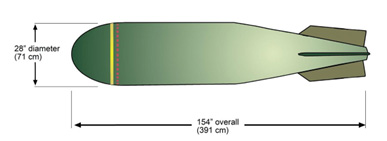
Red Beard was a tactical fission bomb produced in response to joint Admiralty/Air Ministry requirement AW.330/OR.1127 issued in November 1953.
The Red Beard programme seems to have been a watershed as far as AWRE telemetry was concerned. Many problems were encountered, the solutions to which would be generally applicable to future telemetry projects. 17
Initially, there seemed to be interference between the fusing system (developed by RAE) and the telemetry system. There were also signal strength issues caused by an inefficient design of the weapon aerial.
Between 1st June and 1st September 1957, 7 Red Beard air drop tests were made. Only 1 was satisfactory.
These air drop tests were probably made by Canberras flying out of Martlesham Heath. 19
Blue Streak
Blue Streak was a medium-range ballistic missile, the main contractor being de Havilland Propellers. Intended from the outset to carry a nuclear warhead, the telemetry component of this programme was considerably in advance of what had been proposed in Britain to date, in line with the complexity of the weapon.
Blue Streak telemetry appeared to be split into two distinct parts, the systems for the missile body needing some 157 channels, while those for the nose cone (re-entry vehicle) required 53 channels 20. The design responsibility for both components was with the RAE Radio Department.
Detailed work seemed to have started in 1957, with S.R.D.E. involved in frequency band allocation. 21 Basic determination of the number of data channels and other parameters had been started a year earlier by the Guided Weapons department of de Havilland Propellers. 22
It is thought that the telemetry development team at Orford Ness worked on the design of the equipment for the Blue Streak nosecone. See also the IRGON article on the Non-Metallic Gantry, designed for testing of weapon telemetry aerials. Research is ongoing.
Air-ground telemetry – a summary
Typical testing was outlined in a letter to Group Captain Bullock of the MoS, dated 17th March 1958.
“All these trials follow a common overall pattern in that test weapons are assembled at a suitable site where AWRE staff install and check the necessary airborne instrumentation. These weapons are then flown to Orfordness and after a number of flyover tests they are released under predetermined conditions. The behaviour of the weapon components is telemetered both before release and during the actual drop by ground stations housed in permanent buildings on the Orfordness range. The main feature of interest in the telemetry system lies in the measurement of short time intervals below the microsecond range, This is achieved by using fast transient coding and it is this requirement that has necessitated the development of an AWRE telemetry system. The equipment is also capable of continuously monitoring several events by using a conventional sampling system and it has also been adapted to cover special types of trials for investigating vibration, temperature and destruction of parts of the weapon at impact”. 23
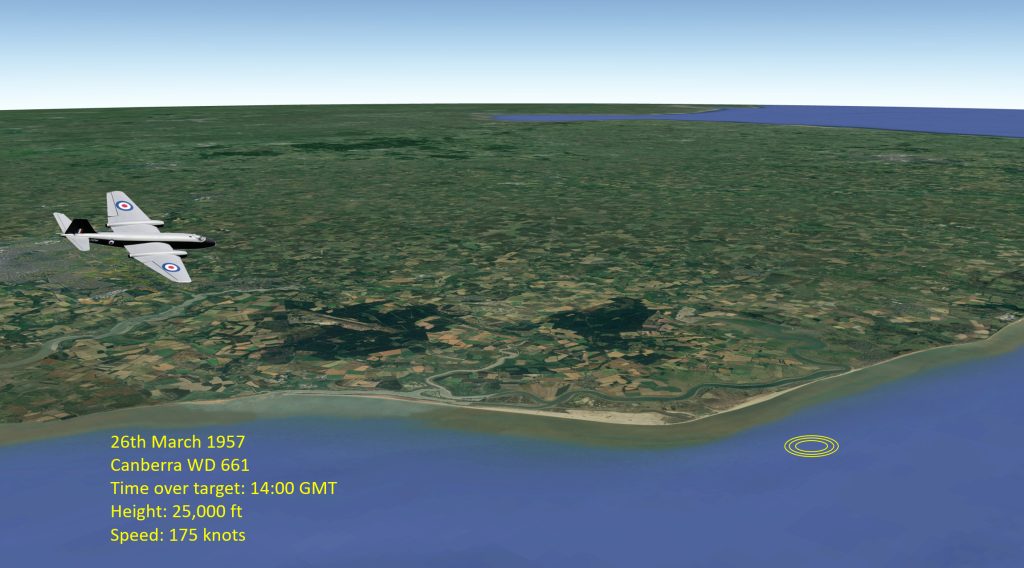
A typical telemetry sortie by Canberra WD 661 over Orford Ness on 26th March 1957. ©IRGON
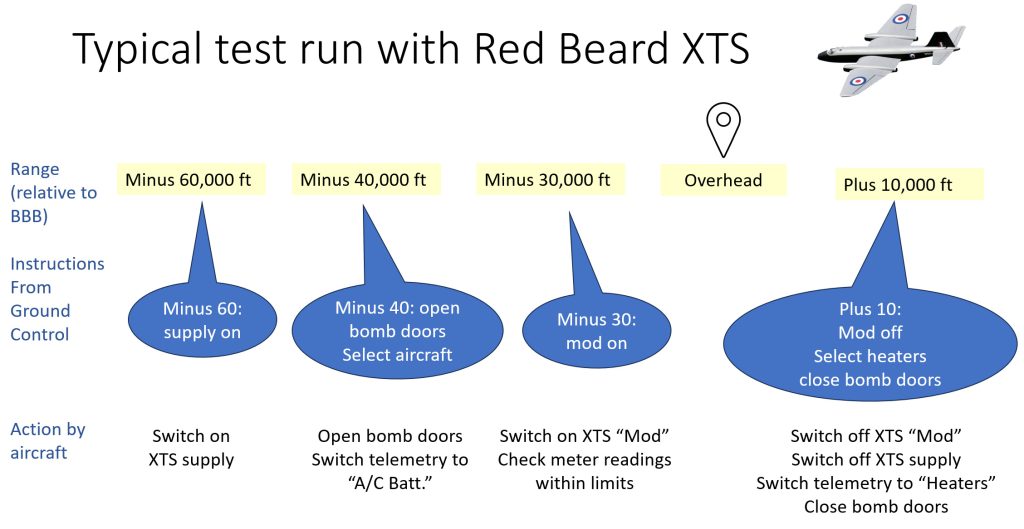
Typical telemetry test run during the development of Red Beard. BBB is the Bomb Ballistic Building and XTS was the radar fuse. 24 ©IRGON
References
- Guided Missiles, Department of the Air Force, Mc.Graw Hill, 1958
- The Origins of Space Telemetry; Wilfrid J. Mayo-Wells, Technology and Culture, Vol. 4 no.4, 1963
- Telemetry for Bomb ballistics: AVIA 6/16188 – TNA via Steve Clifton
- Meeting held at S.R.D.E. on telemetry, 2nd December 1955. From AVIA 13/1235 – TNA via Steve Clifton
- The Secret World of Vickers Guided Weapons, J. Forbat, The History Press
- Guided Missile Policy, K. A. Wood Officer in Charge, AWRE Orfordness, January 1958, from ES 29/8 – TNA via Anne Mallaband
- S.R.D.E Broadband Telemetry System, 30th December 1953. From AVIA 13/1235 – TNA via Steve Clifton
- Radio Department Telemetry Work, Radio/QM15/WLH, 30th November 1955. ibid.
- Notes on Blue Streak Telemetry Position, G.W. 5019/DJL, 28th August 1956. ibid.
- Report of visit to U.S.A., July 1955 (W.T. Blackband, Radio Department, RAE). ibid.
- Telemetry for Blue Streak (Body), memorandum Radio/J6/WLH (W.L. Horwood), 18th January 1956. ibid.
- Staff and Trials Progress, AWRE Orfordness, From ES 29/8 (TNA via Anne Mallaband)
- Echoes and Reflections, Keith Wood, Serendipity Press, 2004. ISBN I-84394-100-7
- A Note on AWRE Blue Danube Trials. W.J. Challens, 12th December 1956. AVIA 65/1160, TNA via Brian Burnell.
- The Real Meaning of the Words: a Pedantic Glossary of British Nuclear Weapons. Richard Moore
- Reference mislaid (Anne photo IMG_0836)
- Staff and Trials progress (Orfordness) 1956 – 1958 . ES 29/8 – TNA via Anne Mallaband
- Transfer of Orfordness range to AWRE. ES 19/69 – TNA via Anne Mallaband
- Black Box Canberras, Dave Forster, Hikoki Publivations, ISBN 9 781902 109534, 2016
- Telemetry for Blue Streak (Head), memorandum Radio/J6/WLH (W.L. Horwood), 18th January 1956. From AVIA 13/1235 – TNA via Steve Clifton
- Frequency Allocation for “Blue Streak” Telemetry – Memo from R. Daniel, S.R.D.E., dated 26th June 1957.
- S.R.D.E. Telemetry in Code 3000, de Havilland Propellers Ltd., G.W. Department, Flight Trials Division, Instrumentation group. 20th September 1956, from AVIA 13/1235 – TNA via Steve Clifton
- Letter from K.D. Bomford, Superintendent of Electronics Trials Division, dated 17th March, 1958. From ES 1/772, TNA via Anne Mallaband
- Fuzing of target marker `Red Beard’ trials: radar pulse switch trials. From AVIA 13/1241, TNA via Steve Clifton