
Introduction
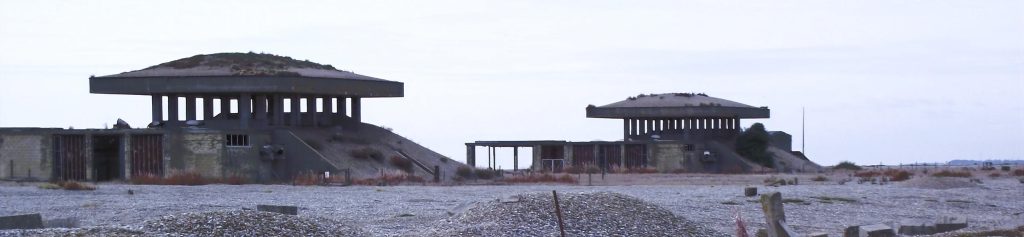
For many people, the first things they see looking across to Orford Ness are the strange and other-worldly ‘Pagodas’. To some extent these mysterious structures characterise the Ness. Some people think they are sinister, others are in awe of the brutalist architecture. For sure, these well-known landmarks on the Suffolk coast have inspired musicians, artists, writers and film-makers.
Atomic Weapons Research Establishment (AWRE) Laboratories 4 & 5
Why were the Pagodas built on Orford Ness?
There was no guarantee that explosive material subjected to environmental testing would not explode and, because of the large masses of high explosive involved, a remote site was needed. Orford Ness fitted the bill, and it already had a history of military trials and testing.
However, some details of the experimental research undertaken are still unknown as relevant files in the National Archives are still closed to the public at this time.
New environmental testing facilities were built for the development of warheads for Blue Water, Sea Slug and Blue Streak. These weapons were expected to create very severe environments for the nuclear payload and the environmental specifications drawn up by the Ministry of Aviation weapon designers needed additional test facilities. The Weapons Group were also committed to develop warheads for new weapon systems, rockets, re-entry heads, and flying bombs which required different and more severe environmental test conditions.
At a meeting of the Environmental Test Facilities in the Weapons Group in April 1960, the United Kingdom Atomic Energy Authority (UKAEA) presented a paper setting out the latest position concerning the expansion of environmental test facilities at Orford Ness and requested approval to proceed with stage 1 of the work at an estimated cost of £860,000. This would be equivalent to about £21 million today, so this was a significant project. The cost was high, partly because of safety and security requirements.
Laboratories 4 and 5 on Orford Ness, a pair of almost identical Vibration Test Buildings were part of this programme. Construction of the ‘Pagodas’, the Ness’ most distinctive structures, started in 1960.
The need to accelerate the developmental work on the atomic bomb and expand the test programme to simulate the conditions non-nuclear components of nuclear weapons might experience during operational use was of paramount importance and the project received political and financial backing.
Furthermore, the cancellation of Blue Streak project in 1960, which was intended to keep an independent British nuclear deterrent, made the provision of these facilities more urgent, since the development of a new warhead was required.
As a result of renewed access to American nuclear know-how and its miniaturised systems, the existing Laboratories 1, 2 and 3 were insufficiently flexible to be used with weapons such as the WE177, the underlying design of which was based on the US W59. Important testing work was needed to anglicise United States’ designs.
The need for flexibility had a significant impact on the designs for the new Laboratories 4 and 5. Laboratory 1, the first purpose-built vibration test facility on the Ness, was effectively designed around two large mechanical vibration machines, mounted in a pit on a substantial concrete base.
Why do the Pagodas have such distinctive structures?
The Pagodas were a major construction project. Their function was unique with their energy absorbing roof and solid sides and floor.
The Vibration Test Buildings 135 and 136, Laboratories 4 & 5, are identical in design – reinforced concrete structures with a large reinforced concrete central chamber 16.5m (54ft) by 7.3m (24ft), and a massive concrete roof, supported on sixteen reinforced concrete columns, covered in shingle. The required flexibility for differing types of vibration and thermal tests was achieved by the provision of slotted mounting rails embedded in the chamber walls. These allowed for different configurations of vibration and/or thermal equipment to be set up on the various axes of the weapons under test. The roof overhung the test cell to contain the danger of debris being ejected from the building should there be an explosion. The upper ‘windows’ of the Pagodas were fitted with double glazed Perspex windows.
The structures were designed to withstand accidental detonation of 180kg (400lbs) of high explosives during the extreme vibration testing and needed a safety radius of 500 metres (550 yards). The design of the structure was the responsibility of the Southern Works Organisation of UKAEA, whose chief architect was G W Dixon, and the design drawings were prepared by C W Glover and Partners. The report on their design noted that ‘the design of such a building is beyond normal architectural or structural practice’.
In determining the best design for the new buildings, experiments were carried out at AWRE Foulness using small amounts of explosives and 1/10 scale models (ES 4/1282). The original monolithic structure model resulted in a wide distribution of debris when subjected to an internal explosion. Subsequent models confirmed mass plus venting produced the best results for not producing wide distribution of building fragments and held disintegrated test equipment. The findings of this study were used to modify the buildings at Aldermaston to accommodate the work that was transferred from Orford Ness.
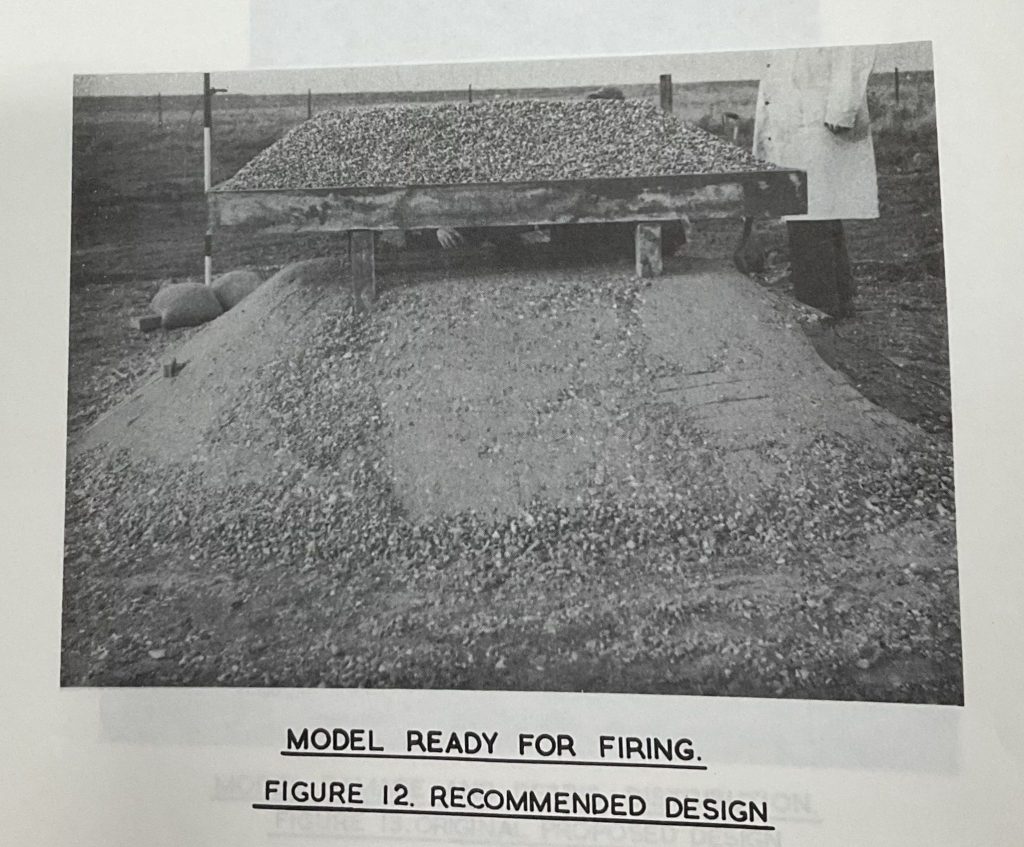
© The National Archives. Contains public sector information licensed under the Open Government Licence v3.0.
Interestingly, before Orford Ness was definitively selected as the environmental testing centre, AWRE commissioned C W Glover to carry out a subsoil survey at AWRE Foulness. It transpired that the geology at Foulness was not suitable to support such substantial structures.
The contract for the building and civil engineering of the Vibration Test Buildings was awarded to Messrs A. Monk and Co. for £160k. The equipment and plant which included the two vibrators to be supplied by Messrs Goodmans and Co. and the thermal enclosures cost £222k. With the required mechanical and electrical installations, the estimated cost for the laboratories was £540k.
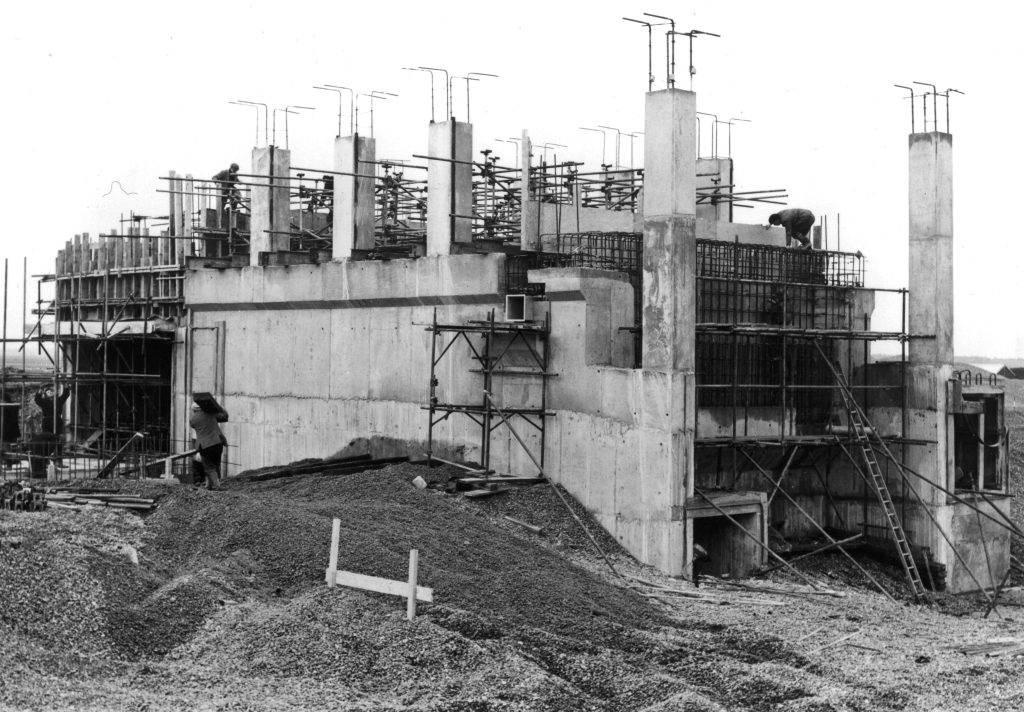
Fortunately, the Pagodas are still standing intact today, so the structural containment was never tested for real. Similar facilities are at Aldermaston.
Who worked in the Pagodas and what did they do?
Based on job adverts in the New Scientist, AWRE were seeking to recruit a ‘senior scientific assistant’ in 1961 to ‘supervise a small team engaged on analysis and presentation of vibration, acceleration.and shock records from environmental trials and to provide a computing service for experimental staff’. The salary was in the range £870 -1,160 p.a., this would be equivalent in purchasing power to about £28,500 today.
It is not known how many environmental trials and experiments were being conducted at this time, at the height of the Cold War. Staff numbers at AWRE Orford Ness reached a peak of 220 in 1961/62. It is estimated that 15+ trials were taking place over 5 days per week with consideration being given to trials being run on a two shift per day basis.
The Trials Team was responsible for all aspects of trials. This included trials operations – the rigging and running of the trials, the assembly and breakdown of warheads and the transport and storage of explosives; maintenance and calibration of trials equipment; the computing, recording and reporting of results; R & D into methods of environmental testing, control techniques and standards. It was important that there was sufficient capacity in the team to ensure the maximum progress on the development projects.
The team included scientific officers, engineers, experimental officers, laboratory technicians and mechanics, as well as ‘Computresses’ who undertook computing and support for the Controller while the trial was in progress.
Trials in Laboratories 4 and 5 involved the testing of explosive components and assemblies. From the report (ES29/5) describing the environmental test facilities, the following is known:
- The explosive limit: 900kg (2,000 lb.) of category X or Y or 180kg (400 1b.) of category ZZ or Z;
- Operation – (a) Vibration testing; (b) Combined thermal and vibration testing;
- All operations controlled from remote station;
- Permanent thermal ducting from inside the laboratory to the exterior for coupling to mobile heating/ cooling plant;
- The testing cell dimensions 32 ft. long by 16 ft. wide by 12 ft. deep;
- Vibrators can be mounted on any three sides and floor of test cell;
- Handling facilities:
- Test items enter cell via hydraulic lift 40 ton capacity.
- Maximum size of items accommodated on turn table within lift 13 ft. long by 4 ft. wide by 6 3/4 ft. high.
- Powered travelling crane within Laboratory 121/2 tons.
- Beams across test cell allow for suspension of test items on vibrators.
- Services
- Electrical – Single phase 240V A.C.; Three phase 415V A.C.; Low voltage 6, 12, 24V D.C.;
- Air: Compressed air to 120 p.s.i.; Vacuum to 20 – 30 in Hg.
- Building heated but not air conditioned.
The weapons being tested were ‘sealed units’. Thus, the test examples had to be especially made to properly simulate the real weapon. This would have required the substitution of the internal fissile material with another material. The explosive components however would have been exactly as fitted in the weapon.
The test pieces were lowered by hydraulic lift onto the floor of the cell which had narrowly spaced steel beams for test rigs to be firmly secured to the structure. Vibrators could be mounted on any three sides and the floor of the cell and the test piece subject to vibration or at the same time as being vibrated objects might also be placed in jackets to simulate extremes of heat and cold, or in a portable altitude chamber to mimic the effects of altitudinal changes.
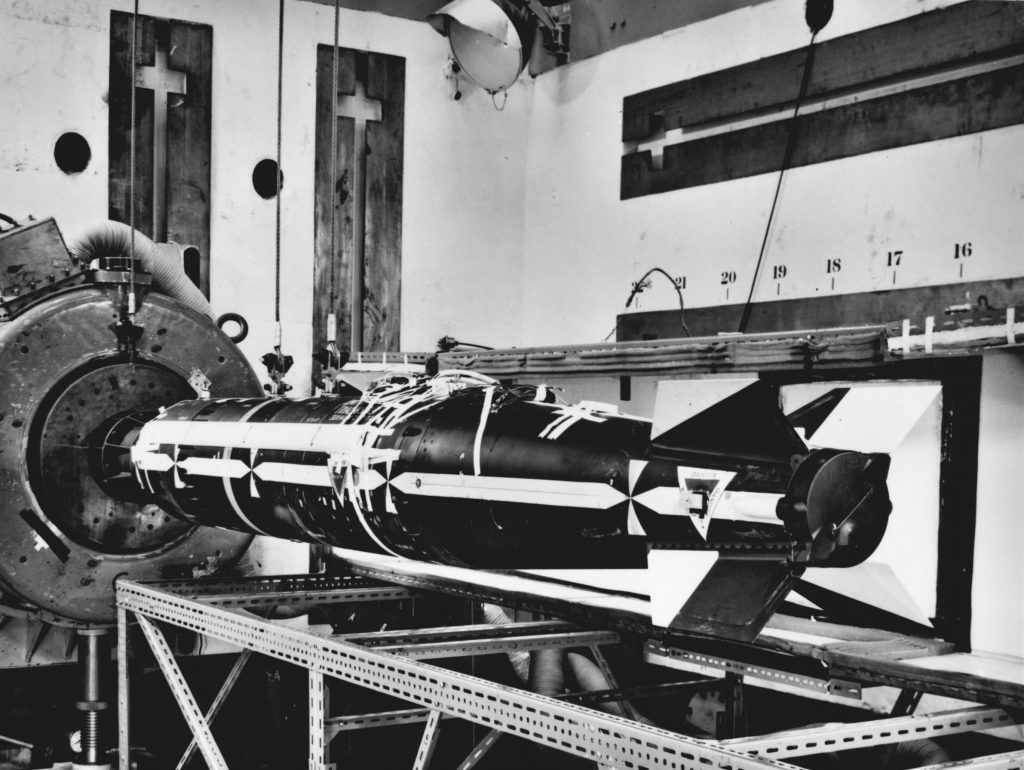
Warhead test specifications required vibration tests which simulated transport environments. Low frequency testing required hydraulic vibrators and the Dowty hydraulic vibrator, a UK machine met the specifications. A contract had been placed with Goodman Industries, for the design, manufacture, testing and commissioning of 50,000 lb. thrust vibrator machine, but the company experienced difficulties in achieving the specification for such a large vibrator. Also, due to programme changes, a machine of 30,000 lb. thrust was adequate to reach any acceleration levels required, and the US Ling 249 machine best met the needs.
All operations were remotely controlled. The laboratories were interconnected with the control room to monitor the weapons while being tested. The environmental tests were supported by comprehensive instrumentation services, both for the control of trials, the analysis of the results produced, and the necessary support from electronic and mechanical workshops.
What was the contribution – what is the legacy?
The mysterious pagodas had a relatively short working life but had a leading role in the UK nuclear programme in the Cold War period. The results of the experiments and trials undertaken in the pagodas contributed to significant developments in weapon technology with innovations in explosives, electronics, and logistics.
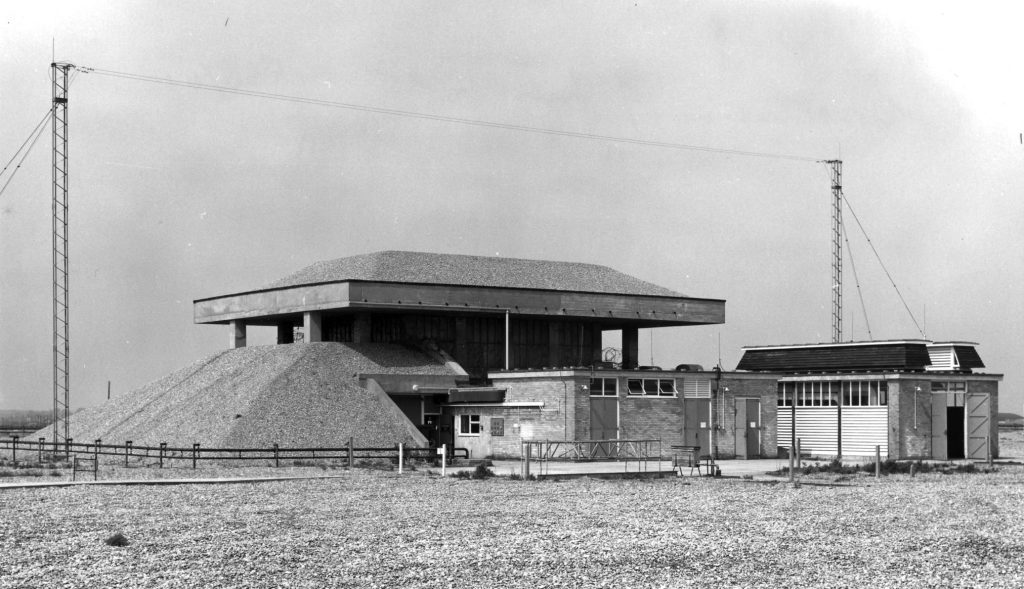
© Crown Copyright / AWE 2021. Contains public sector information licenced under the Open Government Licence V3.0.
However, by 1967 environmental test activity was in decline and AWRE looked for other rechargeable work. A promotional brochure, highlighting Orford Ness’ unique facilities was distributed at exhibitions and to industrial companies as there was spare capacity in these unique facilities. The decision was taken in 1969 to close Orford Ness substation and consolidate all AWRE activity at Aldermaston.
Fifty years on, the pagodas are still standing and contribute to the otherworldly atmosphere on the Ness. Much of the activity that took place in the laboratories is still sketchy or unknown. Therefore, we would be pleased to hear from anyone who worked on the Ness during this period (see ‘contact’ on the website) and wishes to share their experiences.
References: all documents from The National Archives
AB 16/2975: Orfordness; Phase 3
AB 16/2976: Orfordness: Phase 3. Extract from AB 16/2975
ES 4/1282: Design Study for an environmental test building erected at AWRE Orfordness
ES 19/33: Expansion of the environmental test facilities at Orfordness
ES 19/59: Sale of the AWRE Orfordness site to the Ministry of Defence
ES 19/71: Ministry of Defence Working Party on Environmental Testing at AWRE Orfordness: possible rationalisation of other facilities and transfer of work to Orfordness
ES 29/1: AWRE Orfordness: organisation and development of test facilities; part 1.
ES 29/3: AWRE Orfordness: environmental testing facilities
ES 29/5: AWRE Orfordness: an account of an environmental test establishment from 1967 to the closure in 1971
ES 29/8: AWRE Orfordness: staff and trials progress
ES 19/118: Environmental testing facilities at AWRE Orfordness: promotional brochure
ES 11/24: Warhead testing by vibration.
AVIA 65/1258: Atomic Weapons Research Establishment: minutes on vibration test rig.