After the First World War, Orford Ness was closed as an active wartime airfield but retained under a care and maintenance arrangement because of its continuing strategic value. Many temporary huts and wartime structures were removed, but the site was not abandoned. Its isolation, open ranges, and existing military ownership made it useful for future experimental work. Reports from trials carried out during the final months of the war continued to shape RAF thinking, especially Sir Bennett Melvill Jones’s 1920 study of air-to-air gunnery, which became an important technical reference for the next generation of aircraft armament.
During the 1920s, progress at Orford Ness was slow because defence spending was heavily restricted and much of the available aircraft equipment was obsolete. Even so, the site remained valuable as a discreet testing ground. A large prefabricated clerestory barrack replaced earlier temporary huts, suggesting that the authorities expected the Ness to have a more permanent role. By 1924, the RAF reorganised its aircraft and armament testing around its Suffolk bases: Martlesham became the Aeroplane and Armament Experimental Establishment, while Orford Ness reopened as a satellite research station, supported by nearby Felixstowe.
Throughout the inter-war years, Orford Ness generally operated under the authority of larger establishments such as Martlesham, Felixstowe, Bawdsey, or Farnborough. Its official title and ownership changed several times, but its purpose remained consistent: it was a remote, secretive, and highly adaptable experimental station. The work carried out there included trials of guns, ammunition, bombs, and bombsights. Older aircraft such as the DH9a were adequate for early testing because stability mattered more than speed, but as aircraft performance improved, the range technology and supporting infrastructure had to improve as well.
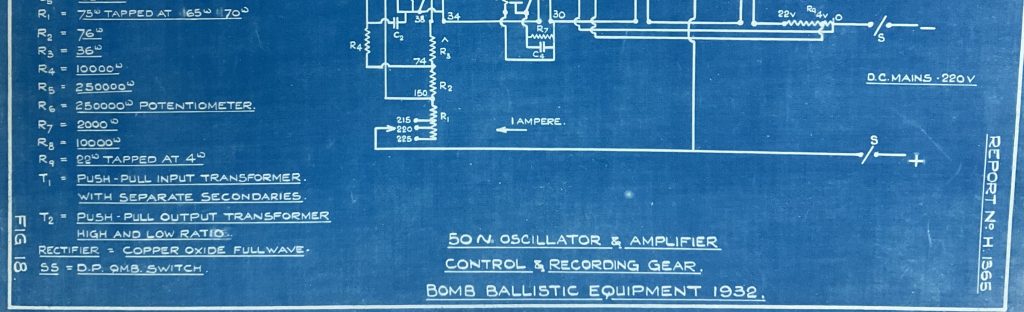
Bomb ballistics
Throughout the Great War, bomb ballistics techniques had been developed on Orford Ness, the techniques and instrumentation available however were limited. After the war, a concerted effort was made to remedy this situation. It was decided to minimise the amount of equipment needed in the aircraft, and to set up a proper ground station with cameras, timing equipment and so on. This led to the Bomb Ballistics dugout in 1928.Eventually, it was realised that even more sophistication was required, plus the dugout had very little room for the observers. The construction of the Bomb Ballistics building in 1933, very close to the dugout location, reflected the growth and increasing sophistication of bombing trials.
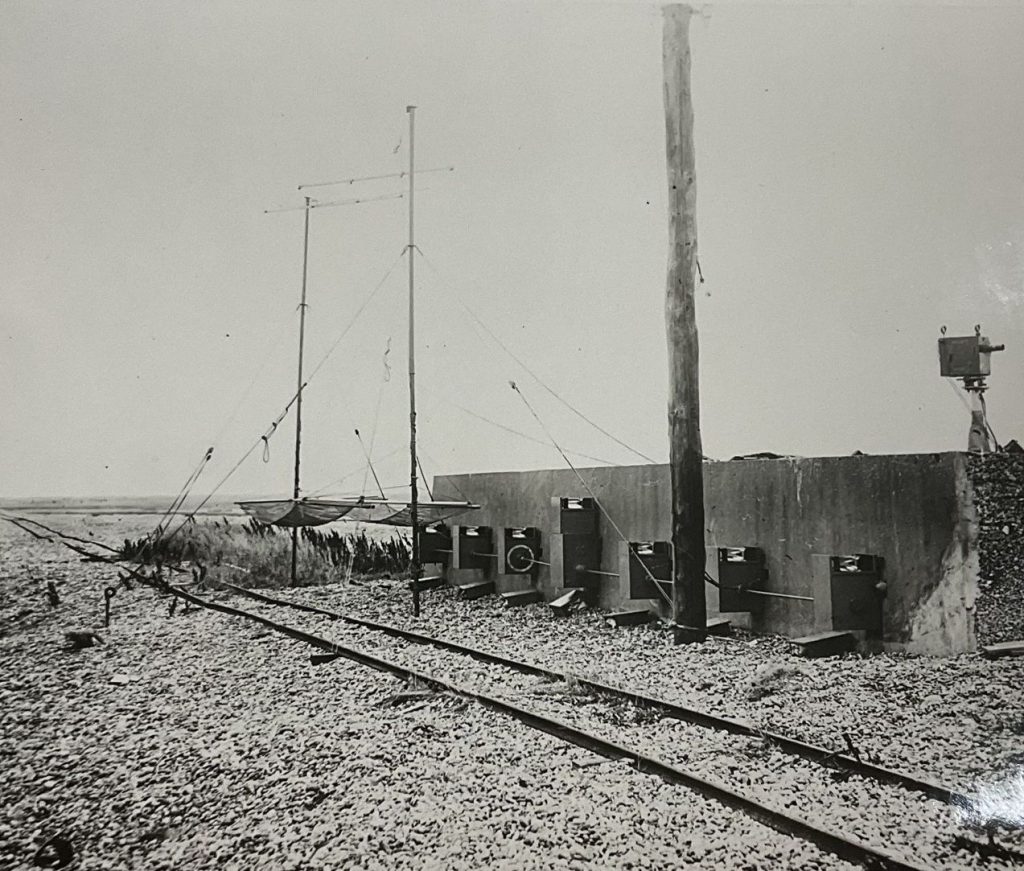
© The National Archives of the UK (TNA): DSIR 36/4621. Contains public sector information licensed under the Open Government Licence v3.0
Navigate to IRGON’s bomb ballistics page
The rotating-loop beacon
One of the most important inter-war experiments at Orford Ness was the rotating-loop beacon trial, which ran from 1929 to 1934. Publicly, the beacon was presented as an aid to marine navigation and civil aviation, almost an electronic substitute for a lighthouse. Privately, however, Air Ministry documents made clear that the RAF valued it chiefly for service aircraft navigation, especially for night flying and possible wartime conditions. This dual purpose required deliberate ambiguity: shipping interests, Trinity House, the Board of Trade, and the Treasury were all involved, while the military significance of the project was carefully disguised.
The beacon worked by transmitting a rotating radio signal from a loop aerial. Operators receiving the signal used changes in its strength, together with marked Morse references and an accurate stopwatch, to calculate their bearing from Orford Ness. The concept was not entirely new, but its potential application to aircraft navigation was important. Aircraft radio equipment was still heavy and limited, so the RAF hoped that a ground-based direction-finding system might reduce the burden on aircrews and improve navigation in poor visibility or darkness.
Orford Ness was chosen for the full-scale trial after other locations were considered. Although it had earlier been rejected as remote, waterlogged, and poorly served by accommodation, it later appeared ideal because of its location, existing military status, and lower cost. Construction began in January 1929. The beacon building was deliberately built without metalwork, with a brick basement and timber upper storeys in an octagonal, windmill-like form. When the apparatus was inaugurated in June 1929, it quickly impressed many mariners, and signals were reported at surprisingly long distances.
Despite its maritime success, the system was less satisfactory for RAF purposes. The need for accurate stopwatch readings created scope for human error, airborne radio equipment remained underdeveloped, night reception was problematic, and the signal could potentially be jammed by an enemy. An interesting account of the difficulties involved in using this system in a single seater aircraft can be found in Almost a Boffin by Eugene Emile “Tubby” Vielle OBE.
After five years, the Air Ministry abandoned the rotating-loop beacon.
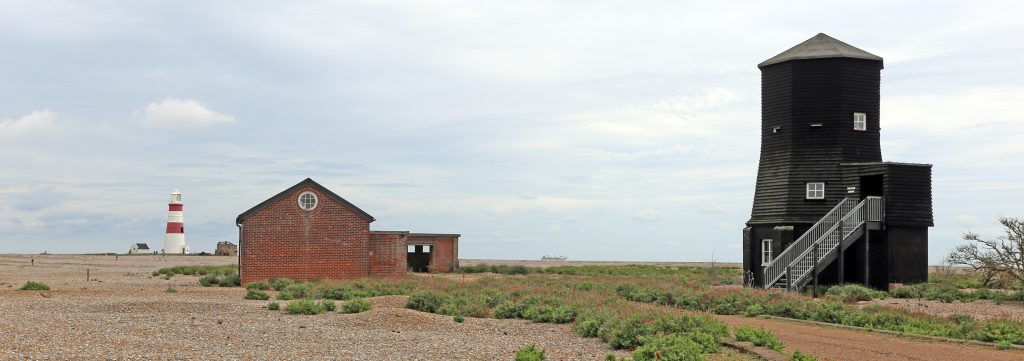
Navigate to IRGON’s Black Beacon page
Radar Research at Orford Ness
The first radar team at Orford Ness was small, young, and under-resourced. It included Bainbridge-Bell, Wilkins, E.G. “Taffy” Bowen, and George Willis, later joined by technicians and specialists from Slough. They worked in difficult conditions, often improvising with borrowed or discarded parts. They had limited accommodation, awkward transport across the River Ore, and strict secrecy. The scientists became known as “islanders,” a term that reflected both their physical isolation and their sense of pioneering identity.
Watson Watt remained based at Slough for much of this period but visited Orford at weekends, using meetings at the Crown and Castle Hotel to guide progress, discuss ideas, and maintain morale. Early trials with aircraft from Martlesham and Felixstowe were encouraging. The team experimented with shorter wavelengths, increased transmitter power, improved pulse length, and better direction-finding. These efforts pointed toward later developments in centimetric and airborne radar.
The programme was not smooth. A demonstration for the Tizard Committee in June 1935 was attempted before the equipment was ready and was spoiled by severe weather. Security was also a constant concern. Cover stories described the work as ionospheric research or other harmless radio experiments. RAF pilots taking part in the trials were not told the true purpose of their flights, although some suspected that the explanations were misleading.
Despite setbacks, the team soon achieved genuine aircraft echoes on routes such as Orford to Bircham Newton. In July 1935, a chance observation of a formation of aircraft suggested that RDF might not only detect aircraft but also estimate the size of bomber formations. This possibility impressed both Watson Watt and Rowe because it pointed toward a practical early-warning system. The team also investigated whether wooden aircraft reflected signals and discussed future applications, including coastal radar chains, gun control, mobile early-warning equipment, and airborne RDF.
Naval involvement encouraged further thought about shorter and less conspicuous wavelengths, a line of development that eventually contributed to centimetric radar and the cavity magnetron. Meanwhile, it became clear that Orford Ness was too limited for the expanding research programme. Watson Watt, Wilkins, and Bowen identified Bawdsey as a better base, and the Air Ministry moved to acquire the estate. This decision marked official acceptance of the idea of a chain of coastal RDF stations roughly every 20 miles, later known as Chain Home.
Orford Ness remained active while Bawdsey was prepared. Through autumn 1935, the team improved height-finding and direction-finding, although delays in obtaining taller masts slowed progress. Nick Carter’s work demonstrated the accuracy of height measurement when an RAF pilot secretly dropped from 9,000 feet to 1,000 feet during a trial and the equipment correctly detected it. This episode also showed how the Ness maintained secrecy through privacy rather than heavy visible security.
Results and the Growth of Chain Home
By December 1935, the Orford team had developed equipment capable of detecting aircraft at significant ranges: around 70 kilometres for aircraft at 7,000 feet and 85 kilometres for aircraft at 15,000 feet, using relatively modest 70-foot masts. That same month, the Treasury approved an RDF chain for the defence of London.
The programme remained vulnerable to technical failure, official doubt, and political opposition. Senior officers worried about jamming, demonstrations sometimes failed, and Lindemann’s opposition caused serious tensions within the scientific advisory system. Even so, Watson Watt successfully defended the case for radar and kept the 1936 RDF chain moving forward. A failed Bawdsey demonstration during the September 1936 air exercise was rescued when the Orford transmitter worked successfully the next day, helping preserve confidence in radar and ending serious support for sound mirrors.
Pioneering radar research at Orford Ness ended in 1937 after work on 13-metre transmission. The team moved on to help establish early Chain Home stations, but the Ness had already played a crucial role. It had provided a secure, practical testing ground where theoretical radio detection became an operational air-defence system. The site’s contribution was therefore not merely technical: it helped transform Britain’s strategic position before the Second World War.
Significance and Legacy
The inter-war work at Orford Ness showed how experimentation, secrecy, and improvisation could produce major military innovation even in a period of financial restraint. Vital progress was made in the field of bomb ballistics. The rotating-loop beacon demonstrated the challenges of adapting radio navigation to military aviation, while the later radar work showed how those challenges could be overcome through more effective science, organisation, and leadership.