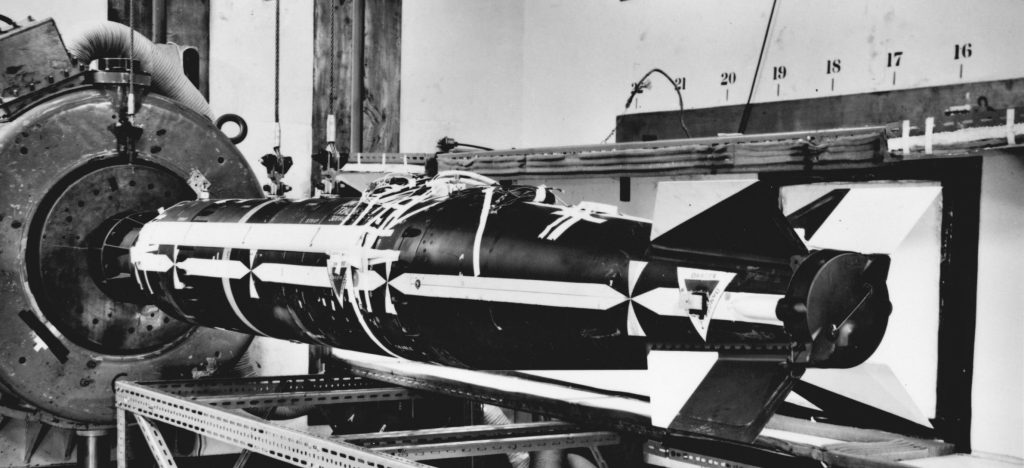
The heading photo shows an instrumented WE.177 weapon attached to a vibrator mounted in the axial position. These vibration tests were often combined with thermal regimes, for this a thermal shroud would have surrounded the weapon. This photo would have been taken in Lab 4 or Lab 5 (the Pagodas), and dates from May, 1967. © Crown Copyright / AWE 2021. Contains public sector information licenced under the Open Government Licence V3.0.
The raison d’être of the AWRE outpost at Orfordness was really the need for sufficient space and isolation to be able to test weapon assemblies in a safe manner. Although the fissionable material was replaced by an inert substitute, the significant amounts of conventional explosive contained in these weapons necessitated an approach similar to that used previously by Royal Ordnance Factories, i.e. well protected buildings separated by a sufficient blast radius.
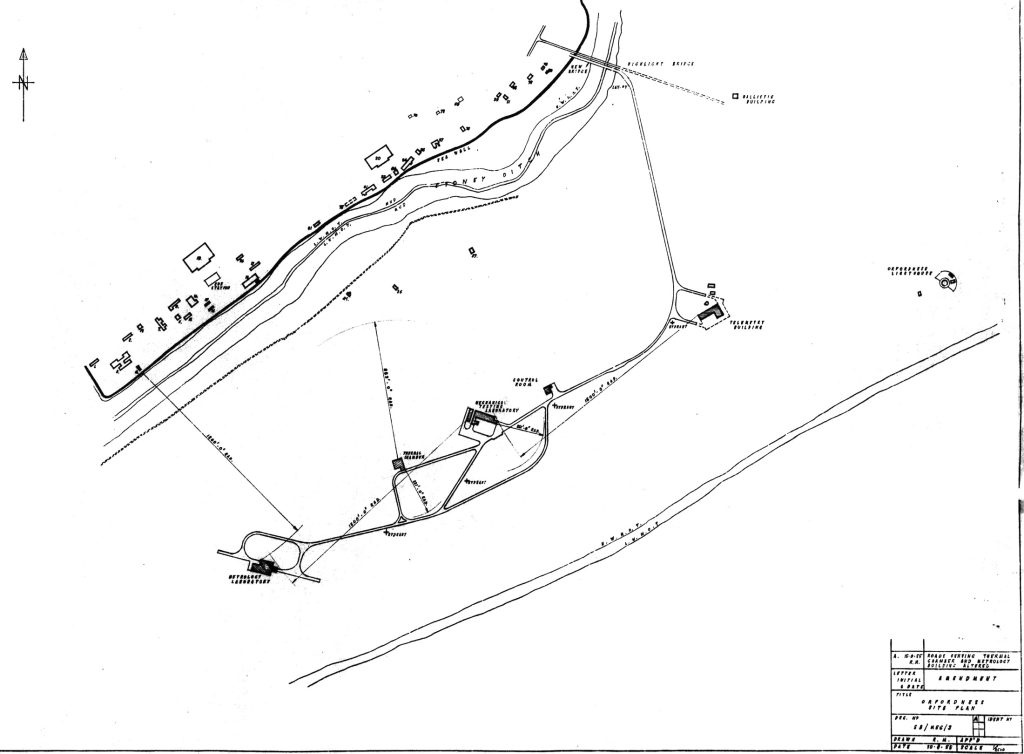
Above: Early AWRE sketch dating from 1955 showing blast radii. This was the main factor in selecting a remote location such as Orford Ness for an AWRE outstation. There was insufficient space at Aldermaston for such construction. © Crown Copyright / AWE 2021. Contains public sector information licenced under the Open Government Licence V3.0.
Prior to, and running for a few years in parallel with the ground testing programme, RAE and AWRE were carrying out system tests of weapon components by instrumented and telemetered overflights of Orford Ness. For example, the very first ballistic drop of Blue Danube was on 6th July 1955 1. Very soon afterwards, systems tests on the same weapon had begun (the first F4 drop, which was a failure, taking place on July 22nd).
These airborne system tests were complex and expensive, and it made sense to carry out as much testing as possible in ground facilities. The bottleneck here was that it took time to build up the Orford Ness test establishment, and to obtain suitable test equipment, which was not available off the shelf at the time.
The ground testing regimes employed covered vibration, shock, centrifuge and thermal testing, and were carried out between 1956 and the early 1970s.
The subject of vibration testing, which was such an important focus for AWRE Orford Ness, will be the subject of another IRGON article in preparation.
References
- RAF Nuclear Deterrent Forces, Humphrey Wynn, The Stationery Office, 1994