Tracking Soviet satellites from Orford Ness
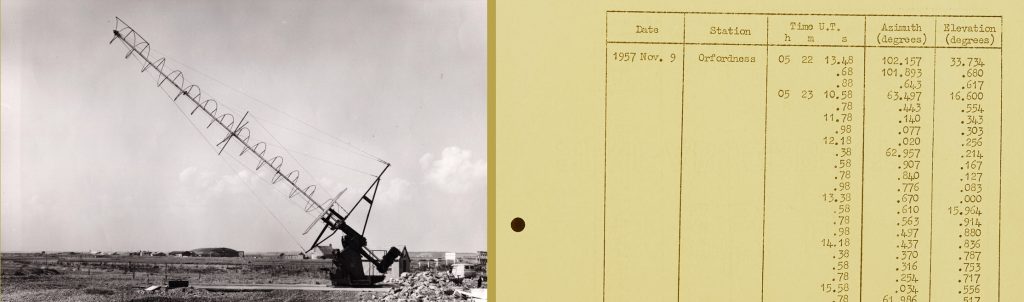
In 1957, an outpost of the Atomic Weapons Research Establishment was operating on Orford Ness. The Ministry of Supply and Royal Aircraft Establishment also had staff on the Ness. Interestingly, the satellite tracking on Orford Ness fell under two auspices: AWRE for radio tracking and RAE for optical. This may have been due to the “crash programme” nature of these activities, rather than a specific plan. Indeed, no records of the Sputnik tracking seem to survive at AWE Aldermaston; it is thanks to the Malvern Radar and Technology History Society that IRGON obtained access to some information inherited from radar pioneer Keith Wood.
Although optical tracking does not belong under the heading “radio and radar”, it has been included here for convenience.
In total, IRGON is aware of three Soviet satellites tracked from Orford Ness: Sputnik 1 and Sputnik 2 in the period 1957-58 and much later, COSMOS 478 (a reconnaissance satellite launched on 25th January 1972).
Sputnik 1
The launch of Sputnik 1, on the 4th of October 1957, took the West by surprise.
Although the Russians had announced their intention to launch an artificial earth satellite at the International Geophysical Year conference in Barcelona over a year before, this information somehow was not taken seriously in front of the Iron Curtain.
The Soviets ensured that their technical breakthrough brought maximum propaganda value. Sputnik 1 had a highly polished surface to maximise its reflectivity 1, and the satellite was launched on a polar orbit so it would pass over nearly all inhabited portions of the earth. Additionally, the International Geophysical Year conferences had agreed on a frequency in the VHF band of 108 MHz as an international satellite frequency. Sputnik 1 however carried radio transmitters not tuned to the agreed frequency, instead broadcasting on the 20 MHz and 40 MHz bands which could be picked up by radio hams.
There was feverish activity on both sides of the Atlantic to find out as much as possible regarding the orbital and other characteristics of Sputnik. Not only radio observations, but optical and infra-red measurements were taken.
The Americans had established a radio tracking system called Minitrack, which consisted of two interferometers, one with aerials separated in the North- South direction and the other with aerials separated in the East-West direction. Once it was realized that Sputnik was transmitting on the lower frequencies, the Naval Research Laboratory started a crash programme to re-engineer Minitrack to the new frequencies to enable tracking of Sputnik; this was managed within 48 hours. 2
Meanwhile, in the United Kingdom, independent efforts were being made to track Sputnik electronically. Besides a Minitrack system installed at the Radio Research Laboratory in Slough, 3 equipment at RAE Farnborough was used, as was the large steerable radio telescope at Jodrell Bank. 4
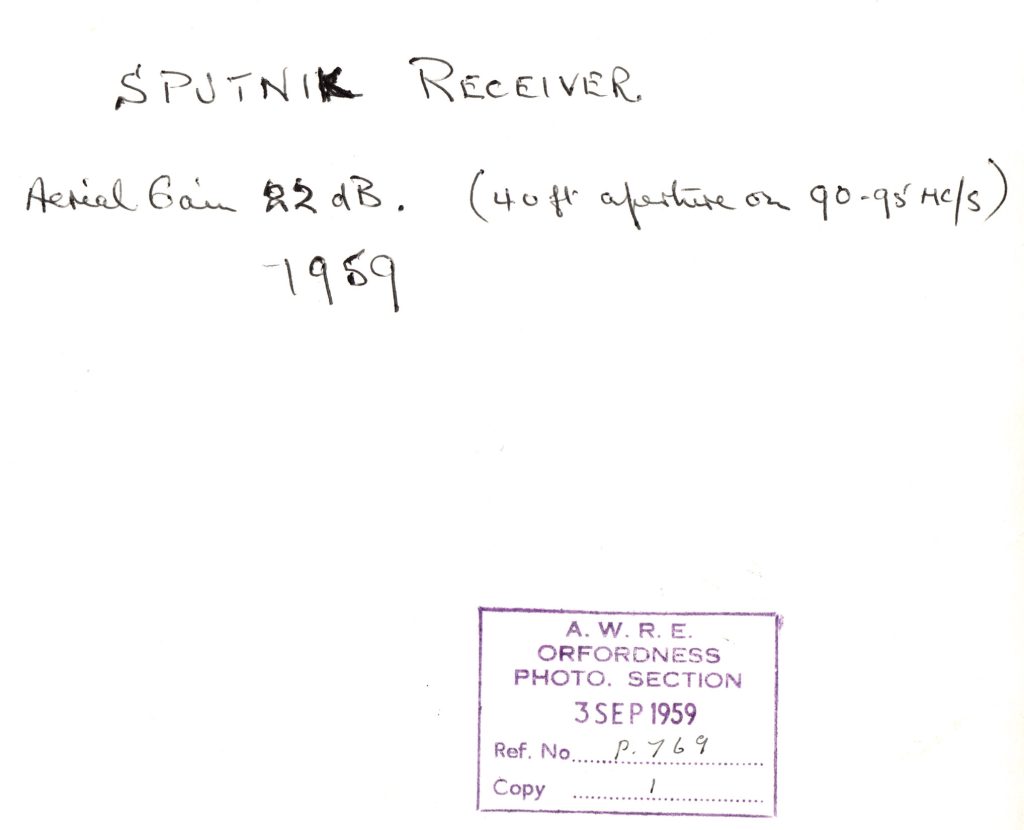
In 1957, Keith Wood was the AWRE superintendent on Orford Ness, and he had been asked by Ieuan Maddock – the Head of Trials at AWRE- to investigate the possibility of a radio tracking setup for Sputnik 1 on Orford Ness. 5 The site was attractive from the point of view of being a radio quiet zone. In typical British fashion, a rough and ready steerable mounting was obtained in the form of a Bofors AA gun. Into the barrel was inserted a 40-foot pole from a pine tree, and this was used as the core of a 13-turn helical antenna. According to Wood’s memoir, this provided a gain of 22dB at 100 MHz * (A slightly different value is given by a hand-written annotation on the back of one of the photographs, which states “40ft aperture at 90-95 Mc/s”).
* This assertion suggests that the aerial was built before Sputnik was launched and started transmitting on the HF band. According to Wood’s memoir, “(Maddock) came into my office and informed me that the Russians were shortly to launch their first communications satellite”.
Given the shock that Sputnik caused to experts and laymen alike, this is surprising. However, there were some intelligence assessments suggesting an imminent launch. The CIA was briefing the National Security Council in early 1957 that the Soviets had acquired the capabilities of orbiting an unmanned satellite vehicle in that same year, 6 and in July a Western scientist overheard a comment of a Soviet scientist saying that “we will launch it this September or October”. 7 Given the intelligence exchange between the US and UK, it is possible that AWRE had some advance warning. In this light, the construction of a VHF helical antenna at very short notice makes sense.
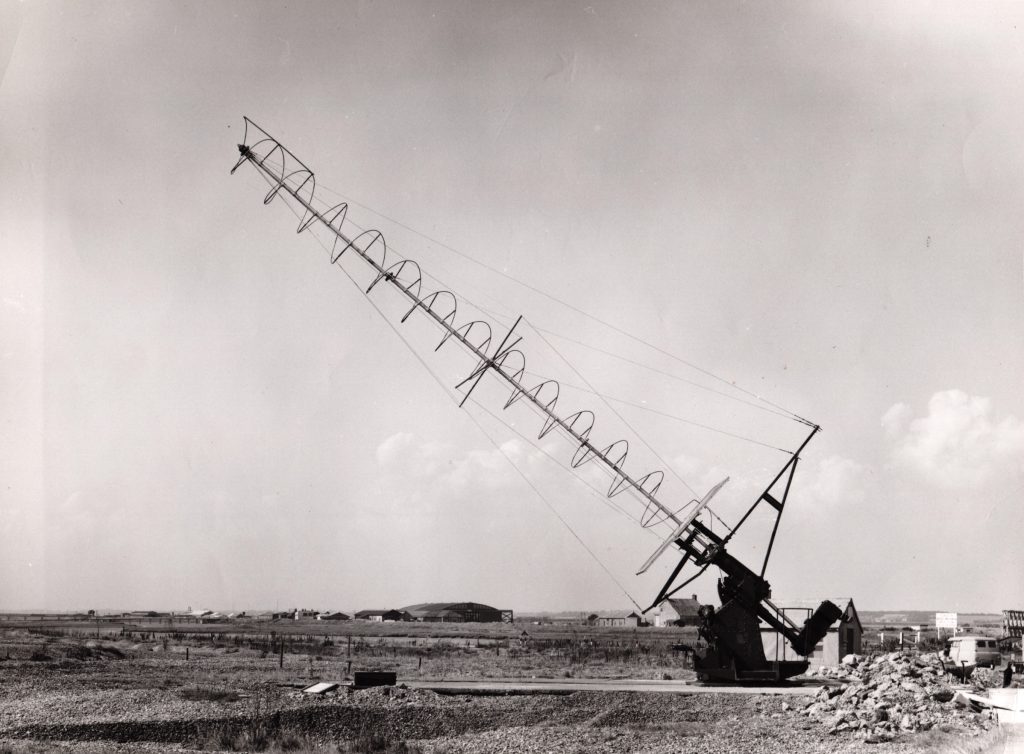
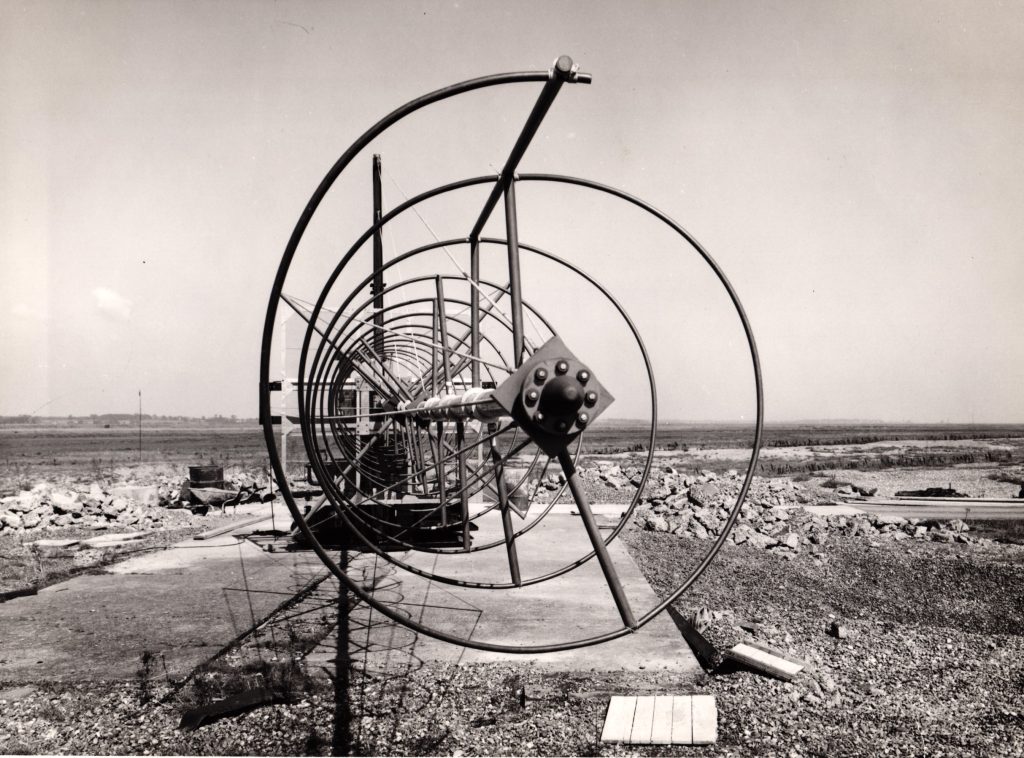
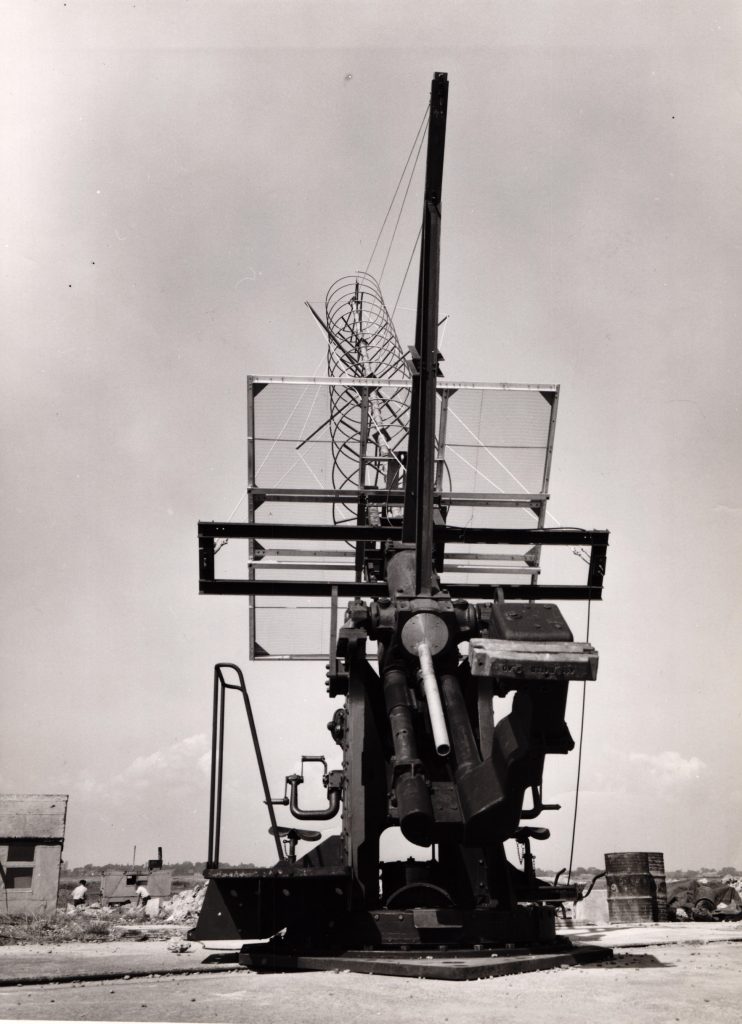
Once Sputnik 1 was launched, and the real frequencies were determined, this aerial would not have been the ideal instrument. However, satisfactory results were said to have been obtained.
Sputnik 2 or 1957β
Barely a month later, on the 3rd of November 1957, the Soviet Union launched a much larger satellite. Weighing over 500 kilograms, this new space vehicle was over 6 times the mass of Sputnik 1. Unlike its predecessor, Sputnik 2 carried some scientific instruments as well as the small dog, Laika.
Sputnik 2 was designed to remain attached to the final stage of the rocket. This meant that the orbiting mass of Sputnik 2 and its attached Blok A final stage had a combined weight of nearly 8 tons, and due to its size, the spacecraft was easy to track optically.
Orford Ness was well equipped with kinetheodolite stations for tracking aircraft and falling bombs. When Sputnik 2 was launched, a project was started under the auspices of RAE Farnborough to obtain accurate orbital data from optical measurements. Existing kinetheodolite equipment at five establishments were used, these being Aberporth, Bramshot, Larkhill, Orford Ness and West Freugh. 8
On Orford Ness, the RAE report gives the coordinates of the observation site as 52º 05´ 24.3” latitude and 1º 33´ 32.9” longitude. This corresponds to the position of kinetheodolite station KT2, which is near the Chinese Wall, not far from Building 84.
The kinetheodolite K.Th.41 had its shutter removed, because a longer exposure of 0.2 seconds was needed at 1 second intervals (in normal daylight operation, the equipment would be exposing 4 or 5 frames per second).
COSMOS 478
This satellite was tracked in an experiment using the Cobra Mist OTHR. Details are in preparation.
References
- The Rocket, The History and Development of Rocket and Missile Technology, David Baker, New Cavendish Books, 1978
- Electronic Industries, November 1957
- Radio and Photographic Observations of Artificial Satellites, D. H. Shinn & N. R. Phelp,
The Journal of the British Institution Of Radio Engineers, Volume 23, June 1962 - https://www.jodrellbank.net/explore/heritage/the-story-of-jodrell-bank/ retrieved 27th July 2024
- Echoes and Reflections, Keith Wood, Serendipity Press 2004
- Soviet Earth Satellite capabilities, CIA NSC briefing, January 24, 1957
- Comment of a Soviet Scientist on the Soviet Earth Satellite, CIA teletyped information report, 17th July 1957
- AVIA 6/18966, A Catalogue of Kinetheodolite Observations of the Russian Earth Satellite 1957β. RAE Farnborough Technical Memorandum No. G.W.355, R.H. Merson and P.B. Nuttall Smith (1959). The National Archives via Steve Clifton